
- Main
- / View Articles
- / Volume 8 No 2 2026
- / 3
Extrusion-Based Additive Manufacturing of Polymer-Ceramic Composites and Ceramic Components Using Highly-Filled Feedstocks: A Review
Authors
S. Mahboubizadeh 1 , A. Jaberi 2 , E.N. Dresvyanina 2 , A. Taherkhani 3 , S. Ashouri 31 Department of Materials Science and Engineering, Islamic Azad University, Science and Research Branch, Tehran, 1477893855, Iran
2 Institute of Textiles and Fashion, Saint Petersburg State University of Industrial Technologies and Design, Bolshaya Morskaya, 18, Saint Petersburg, 191186, Russia
3 Department of Engineering, Islamic Azad University, Science and Research Department Branch, Tehran, 1477893855, Iran
Abstract
Extrusion-based additive manufacturing has emerged as a powerful technique for fabricating polymer-ceramic composites with complex geometries. By enabling layer-by-layer deposition without the need for molds, this process significantly reduces material waste and manufacturing costs, particularly for low-volume and customized production. Among various additive manufacturing technologies, extrusion-based 3D printing methods are widely adopted owing to their cost-effectiveness, design flexibility, and broad material compatibility. These processes typically utilize polymers as binders or matrices, combined with high loadings of ceramic powders and functional additives, where the ceramic phase plays a dominant role in defining the final mechanical, thermal, and functional properties of the component. This review provides a comprehensive overview of extrusion-based additive manufacturing of polymer-ceramic composites. It systematically examines the key material systems, binder formulations, processing routes, post-processing strategies, and critical parameters that govern microstructural development and overall performance.
Keywords
Additive manufacturing; Polymer composites; Ceramic powder; Extrusion; 3D printing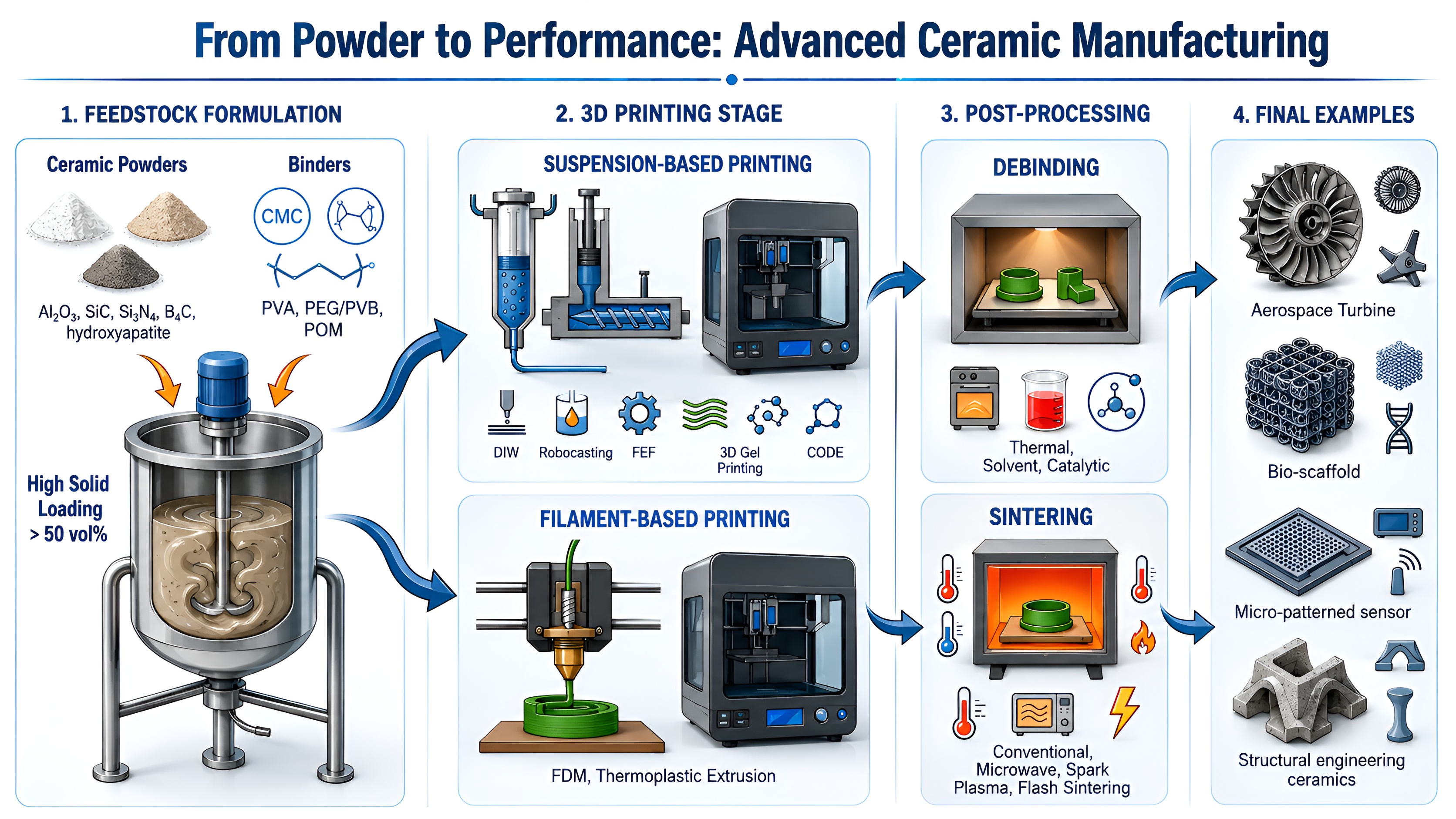
- M. Pelanconi, A. Ortona. Review on the design approaches of cellular architectures produced by additive manufacturing. In: M Meboldt, C. Klahn (Eds.). Industrializing Additive Manufacturing. AMPA 2020. Springer, Cham, 2021, pp. 52–64.
- A. Villa, P.K. Gianchandani, F. Baino. Sustainable approaches for the additive manufacturing of ceramic materials. Ceramics, 2024, vol. 7, no. 1, pp. 291–309.
- T.D. Ngo, A. Kashani, G. Imbalzano, K.T.Q. Nguyen, D. Hui. Additive manufacturing (3D printing): A review of materials, methods, applications and challenges. Composites Part B: Engineering, 2018, vol. 143, pp. 172–196.
- R. Spina, L. Morfini. Material extrusion additive manufacturing of ceramics: A review on filament-based process. Materials, 2024, vol. 17, no. 11, art. no. 2779.
- A. Jaberi, E.N. Dresvyanina. Sustainable polymer composites from industrial wastes. Reviews on Advanced Materials and Technologies, 2025, vol. 7, no. 1, pp. 24–52.
- A. Patil, A. Patel, R. Purohit. An overview of polymeric materials for automotive applications. Materials Today: Proceedings, 2017, vol. 4, no. 2, pp. 3807–3815.
- H. Lipson, M. Kurman. Fabricated: The New World of 3D Printing. John Wiley & Sons, Inc., 2013, pp. 1–5.
- D. Espalin, D.W. Muse, E. MacDonald, R.B. Wicker. 3D printing multifunctionality: Structures with electronics. International Journal of Advanced Manufacturing Technology, 2014, vol. 72, no. 5–8, pp. 963–978.
- G. Saberi, A. Hadian, S. Mahboubizadeh, A. Asefnejad. Natural polymeric reinforcement during 3D-printing in bone regeneration. In: The 12th International Conference on Materials Science & Metallurgical Engineering, Tehran, 2023.
- I.L. de Camargo, C.A. Fortulan, H.A. Colorado. A review on the ceramic additive manufacturing technologies and availability of equipment and materials. Ceramica, 2022, vol. 68, no. 387, pp. 329–347.
- S.J. Rodrigues, R.P. Chartoff, D.A. Klosterman, M. Agarwala, N. Hecht. Solid freeform fabrication of functional silicon nitride ceramics by laminated object manufacturing. In: International Solid Freeform Fabrication Symposium, Austin, TX, USA, 2000.
- A. Zocca, J. Günster. LSD-based 3D printing of alumina ceramics. Journal of Ceramic Science and Technology, 2017, vol. 8, no. 1, pp. 141–148.
- Y. Lakhdar, C. Tuck, J. Binner, A. Terry, R. Goodridge. Additive manufacturing of advanced ceramic materials. Progress in Materials Science, 2021, vol. 116, art. no. 100736.
- S.B. Balani, S.H. Ghaffar, M. Chougan, E. Pei, E. Şahin. Processes and materials used for direct writing technologies: A review. Results in Engineering, 2021, vol. 11, art. no. 100257.
- V. Monfared, H.R. Bakhsheshi-Rad, S. Ramakrishna, M. Razzaghi, F. Berto. A brief review on additive manufacturing of polymeric composites and nanocomposites. Micromachines, 2021, vol. 12, no. 6, art. no. 704.
- U. Scheithauer, E. Schwarzer, H.J. Richter, T. Moritz. Thermoplastic 3D printing – An additive manufacturing method for producing dense ceramics. International Journal of Applied Ceramic Technology, 2015, vol. 12, no. 1, pp. 26–31.
- M.A. Roach, D. Keicher, E. Maines, B. Wall, C. Wall, J. Lavin, S. Whetten, L. Evans. Mechanical challenges of 3D printing ceramics using digital light processing. In: International Solid Freeform Fabrication Symposium, Austin, TX, USA, 2018.
- E.D. Lemma, B. Spagnolo, M. De Vittorio, F. Pisanello. Studying cell mechanobiology in 3D: The two-photon lithography approach. Trends in Biotechnology, 2018, vol. 37, no. 4, pp. 358–372.
- D.A. Klosterman, R.P. Chartoff, B. Priore, N. Osborne, G. Graves, A. Lightman, S.S. Pak, J. Weaver. Structural composites via laminated object manufacturing (LOM). In: International Solid Freeform Fabrication Symposium, Austin, TX, USA, 1996.
- N.R.F.A. Silva, L. Witek, P.G. Coelho, V.P. Thompson, E.D. Rekow, J. Smay. Additive CAD/CAM process for dental prostheses. Journal of Prosthodontics, 2011, vol. 20, no. 2, pp. 93–96.
- K. Rane, M. Strano. A comprehensive review of extrusion-based additive manufacturing processes for rapid production of metallic and ceramic parts. International Journal of Advanced Manufacturing Technology, 2019, vol. 7, no. 2, pp. 155–173.
- S. Lamnini, H. Elsayed, Y. Lakhdar, F. Baino, F. Smeacetto, E. Bernardo. Robocasting of advanced ceramics: Ink optimization and protocol to predict the printing parameters – A review. Heliyon, 2022, vol. 8, no. 9, art. no. e10651.
- W. Li, A. Armani, D. McMillen, M. Leu, G. Hilmas, J. Watts. Additive manufacturing of zirconia parts with organic sacrificial supports. International Journal of Applied Ceramic Technology, 2020, vol. 17, no. 4, pp. 1544–1553.
- A. Maguire, N. Pottackal, M.A.S.R. Saadi, M.M. Rahman, P.M. Ajayan. Additive manufacturing of polymer-based structures by extrusion technologies. Oxford Open Materials Science, 2021, vol. 1, no. 1, art. no. itaa004.
- T. Lacelle, K.L. Sampson, H. Yazdani Sarvestani, A. Rahimizadeh, J. Barroeta Robles, M. Mirkhalaf, M. Rafiee, M.B. Jakubinek, C. Paquet, B. Ashrafi. Additive manufacturing of polymer derived ceramics: Materials, methods, and applications. APL Materials, 2023, vol. 11, no. 7, art. no. 070602.
- A. Kulkarni, G.D. Sorarù, J.M. Pearce. Polymer-derived SiOC replica of material extrusion-based 3-D printed plastics. Additive Manufacturing, 2020, vol. 32, art. no. 100988.
- L.K. Tsui, E. Maines, L. Evans, D. Keicher, J. Lavin. Additive manufacturing of alumina components by extrusion of in-situ UV-cured pastes. In: Proceedings of the 29th Annual International Solid Freeform Fabrication Symposium, 2018, pp. 951–961.
- S. Tang, L. Yang, G. Li, X. Liu, Z. Fan. 3D printing of highly-loaded slurries via layered extrusion forming: Parameters optimization and control. Additive Manufacturing, 2019, vol. 28, pp. 546–553.
- J. Gonzalez-Gutierrez, S. Cano, S. Schuschnigg, C. Kukla, J. Sapkota, C. Holzer. Additive manufacturing of metallic and ceramic components by the material extrusion of highly-filled polymers: A review and future perspectives. Materials, 2018, vol. 11, no. 5, art. no. 840.
- F. Lebas, F. Marie, S. Marinel, C. Manière. A comparative study of CMC and HPMC binders for direct ink writing of ceramics. Journal of the American Ceramic Society, 2026, vol. 109, no. 2, art. no. e70565.
- K. Mitchell, W. Hua, E. Bandala, A.K. Gaharwar, Y. Jin. Particle–polymer interactions for 3D printing material design. Chemical Physics Reviews, 2024, vol. 5, no. 1, art. no. 011305.
- H. Hur, Y.J. Park, D.-H. Kim, J.W. Ko. Material extrusion for ceramic additive manufacturing with polymer-free ceramic precursor binder. Materials & Design, 2022, vol. 221, art. no. 110930.
- J. Gonzalez-Gutierrez, G.B. Stringari, B. Zupancic, G. Kubyshkina, B. Von Bernstorff, I. Emri. Time-dependent properties of multimodal polyoxymethylene based binder for powder injection molding. Journal of Solid Mechanics and Materials Engineering, 2012, vol. 6, no. 6, pp. 419–430.
- V. Tyagi, A. Thakur. Applications of biodegradable carboxymethyl cellulose-based composites. Results in Materials, 2023, vol. 20, art. no. 100481.
- P. Zhou, H. Qi, Z. Zhu, H. Qin, H. Li, C. Chu, M. Yan. Development of SiC/PVB composite powders for selective laser sintering additive manufacturing of SiC. Materials, 2018, vol. 11, no. 10, art. no. 2012.
- I. Oliver, J.A. Conesa, A. Fullana. Thermal decomposition of bio-based plastic materials. Molecules, 2024, vol. 29, no. 13, art. no. 3195.
- T. Yu, Z. Zhang, Q. Liu, R. Kuliiev, N. Orlovskaya, D. Wu. Extrusion-based additive manufacturing of yttria-partially-stabilized zirconia ceramics. Ceramics International, 2019, vol. 46, no. 4, pp. 5020–5027.
- A. Hadian, J. Duckek, A. Parrilli, A. Liersch, F. Clemens. Additive manufacturing of fiber-reinforced zirconia-toughened alumina ceramic matrix composites by material extrusion-based technology. Advanced Engineering Materials, 2024, vol. 26, no. 18, art. no. 2302158.
- E.F.C. Correa, E.A.T. Barahona, J.B.C. Castelló. Additive manufacturing of ceramic materials via direct ink writing (DIW): A review. Ceramics, 2026, vol. 9, no. 2, art. no. 16.
- S. Bhandari, P. Veteška, G. Vajpayee, M. Hinterstein, Ľ. Bača, Z. Hajdúchová, Z. Špitalský, G. Franchin, M. Janek. Material-extrusion based additive manufacturing of BaTiO3 ceramics: From filament production to sintered properties. Additive Manufacturing, 2024, vol. 88, art. no. 104238.
- T.G. Aguirre, C.L. Cramer, D.J. Mitchell. Review of additive manufacturing and densification techniques for the net- and near net-shaping of geometrically complex silicon nitride components. Journal of the European Ceramic Society, 2021, vol. 42, no. 3, pp. 735–743.
- A. Goulas, B. Ozkan, A. Ketharam, S. Saremi-Yarahmadi, B. Vaidhyanathan. Additive manufacturing and characterisation of silicon carbide components fabricated using material extrusion-based fused filament fabrication. Ceramics International, 2025, vol. 51, no. 26, pp. 50779–50786.
- D. Ni, Y. Cheng, J. Zhang, J.-X. Liu, J. Zou, B. Chen, H. Wu, H. Li, S. Dong, J. Han, X. Zhang, Q. Fu, G.-J. Zhang. Advances in ultra-high temperature ceramics, composites, and coatings. Journal of Advanced Ceramics, 2021, vol. 11, no. 1, pp. 1–56.
- M.J. Zafar, D. Zhu, Z. Zhang. 3D printing of bioceramics for bone tissue engineering. Materials, 2019, vol. 12, no. 20, art. no. 3361.
- M. Thangavel, R.E. Selvam. Review of physical, mechanical, and biological characteristics of 3D-printed bioceramic scaffolds for bone tissue engineering applications. ACS Biomaterials Science & Engineering, 2022, vol. 8, no. 12, pp. 5060–5093.
- S. Whyman, K.M. Arif, J. Potgieter. Design and development of an extrusion system for 3D printing biopolymer pellets. The International Journal of Advanced Manufacturing Technology, 2018, vol. 96, no. 9–12, pp. 3417–3428.
- A. La Gala, R. Fiorio, M. Erkoç, L. Cardon, D.R. D'hooge. Theoretical evaluation of the melting efficiency for the single-screw micro-extrusion process: The case of 3D printing of ABS. Processes, 2020, vol. 8, no. 11, art. no. 1522.
- M. Fanous, S. Gold, S. Muller, S. Hirsch, J. Ogorka, G. Imanidis. Simplification of fused deposition modeling 3D-printing paradigm: Feasibility of 1-step direct powder printing for immediate release dosage form production. International Journal of Pharmaceutics, 2020, vol. 578, art. no. 119124.
- C.F. Guo, M. Zhang, B. Bhandari. A comparative study between syringe-based and screw-based 3D food printers by computational simulation. Computers and Electronics in Agriculture, 2019, vol. 162, pp. 397–404.
- A. Goyanes, N. Allahham, S.J. Trenfield, E. Stoyanov, S. Gaisford, A.W. Basit. Direct powder extrusion 3D printing: Fabrication of drug products using a novel single-step process. International Journal of Pharmaceutics, 2019, vol. 567, art. no. 118471.
- C.T. Joseph, T.A. Baer, P. Calvert. Recent developments in freeform fabrication of dense ceramics from slurry deposition. In: International Solid Freeform Fabrication Symposium, Austin, TX, USA, 1997.
- L.M. Rueschhoff, W.J. Costakis, M.J. Michie, J.P. Youngblood, R.W. Trice. Additive manufacturing of dense ceramic parts via direct ink writing of aqueous alumina suspensions. International Journal of Applied Ceramic Technology, 2016, vol. 13, no. 5, pp. 821–830.
- Q. Fu, E. Saiz, A.P. Tomsia. Direct ink writing of highly porous and strong glass scaffolds for load-bearing bone defects repair and regeneration. Acta Biomaterialia, 2011, vol. 7, no. 10, pp. 3547–3554.
- M.C. Leu, L. Tang, B.K. Deuser, R.G. Landers, G. Hilmas, S.C. Zhang, J.L. Watts. Freeze-form extrusion fabrication of composite structures. In: 22nd Annual International Solid Freeform Fabrication Symposium, Austin, TX, USA, 2011, pp. 111–124.
- T. Schlordt, S. Schwanke, F. Keppner, T. Fey, N. Travitzky, P. Greil. Robocasting of alumina hollow filament lattice structures. Journal of the European Ceramic Society, 2013, vol. 33, no. 15–16, pp. 3243–3248.
- W.J. Costakis, L.M. Rueschhoff, A.I. Diaz-Cano, J.P. Youngblood, R.W. Trice. Additive manufacturing of boron carbide via continuous filament direct ink writing of aqueous ceramic suspensions. Journal of the European Ceramic Society, 2016, vol. 36, no. 14, pp. 3249–3256.
- F.J. Martínez-Vázquez, A. Pajares, P. Miranda. A simple graphite-based support material for robocasting of ceramic parts. Journal of the European Ceramic Society, 2017, vol. 38, no. 4, pp. 2247–2250.
- M. Acosta, V.L. Wiesner, C.J. Martinez, R.W. Trice, J.P. Youngblood. Effect of polyvinylpyrrolidone additions on the rheology of aqueous, highly loaded alumina suspensions. Journal of the American Ceramic Society, 2013, vol. 96, no. 5, pp. 1372–1382.
- S.S. Nadkarni, J.E. Smay. Concentrated barium titanate colloidal gels prepared by bridging flocculation for use in solid freeform fabrication. Journal of the American Ceramic Society, 2006, vol. 89, no. 1, pp. 96–103.
- A. Marnot, A. Dobbs, B. Brettmann. Material extrusion additive manufacturing of dense pastes consisting of macroscopic particles. MRS Communications, 2022, vol. 12, no. 5, pp. 483–494.
- L.C. Hwa, S. Rajoo, A.M. Noor, N. Ahmad, M.B. Uday. Recent advances in 3D printing of porous ceramics: A review. Current Opinion in Solid State and Materials Science, 2017, vol. 21, no. 6, pp. 323–347.
- J.A. Lewis, J.E. Smay, J. Stuecker, J. Cesarano III. Direct ink writing of three-dimensional ceramic structures. Journal of the American Ceramic Society, 2006, vol. 89, no. 12, pp. 3599–3609.
- M. Mohammadi, P. Pascaud-Mathieu, V. Allizond, J.-M. Tulliani, B. Coppola, G. Banche, C. Chaput, A.M. Cuffini, F. Rossignol, P. Palmero. Robocasting of single and multi-functional calcium phosphate scaffolds and its hybridization with conventional techniques: Design, fabrication and characterization. Applied Sciences, 2020, vol. 10, no. 23, art. no. 8677.
- L. Čelko, V. Gutiérrez-Cano, M. Casas-Luna, J. Matula, C. Oliver-Urrutia, M. Remešová, K. Dvořák, T. Zikmund, J. Kaiser, E.B. Montufar. Characterization of porosity and hollow defects in ceramic objects built by extrusion additive manufacturing. Additive Manufacturing, 2021, vol. 47, art. no. 102272.
- L. Wahl, M. Lorenz, J. Biggemann, N. Travitzky. Robocasting of reaction bonded silicon carbide structures. Journal of the European Ceramic Society, 2019, vol. 39, no. 15, pp. 4520–4526.
- J. Smay, J. Cesarano III, J.A. Lewis. Colloidal inks for directed assembly of 3-D periodic structures. Langmuir, 2002, vol. 18, no. 14, pp. 5429–5437.
- B.A. Tuttle, J.E. Smay, J. Cesarano III, J.A. Voigt, T.W. Scofield, W.R. Olson, J.A. Lewis. Robocast Pb(Zr0.95Ti0.05)O3 ceramic monoliths and composites. Journal of the American Ceramic Society, 2001, vol. 84, no. 4, pp. 872–874.
- E. Feilden, E. García-Tuñón, F. Giuliani, E. Saiz, L. Vandeperre. Robocasting of structural ceramic parts with hydrogel inks. Journal of the European Ceramic Society, 2016, vol. 36, no. 10, pp. 2525–2533.
- Y. Xia, Z. Lu, J. Cao, K. Miao, J. Li, D. Li. Microstructure and mechanical property of Cf/SiC core/shell composite fabricated by direct ink writing. Scripta Materialia, 2019, vol. 165, pp. 84–88.
- J.W. Kemp, N.S. Hmeidat, B.G. Compton. Boron nitride-reinforced polysilazane-derived ceramic composites via direct-ink writing. Journal of the American Ceramic Society, 2020, vol. 103, no. 8, pp. 4043–4050.
- H. Shao, X. Yang, Y. He, J. Fu, L. Liu, L. Ma, L. Zhang, G. Yang, C. Gao, Z. Gou. Bioactive glass-reinforced bioceramic ink writing scaffolds: Sintering, microstructure and mechanical behavior. Biofabrication, 2015, vol. 7, no. 3, art. no. 035010.
- L. Yang, X. Zeng, A. Ditta, B. Feng, L. Su, Y. Zhang. Preliminary 3D printing of large inclined-shaped alumina ceramic parts by direct ink writing. Journal of Advanced Ceramics, 2020, vol. 9, no. 3, pp. 312–319.
- C. Okyay, B. Sağbaş. Determining optimal robocasting process parameters for additive manufacturing of ceramic parts. International Journal of 3D Printing Technologies and Digital Industry, 2021, vol. 5, no. 3, pp. 435–444.
- R. Vaidyanathan, J. Walish, J.L. Lombardi, S. Kasichainula, P. Calvert, K.C. Cooper. Extrusion freeforming of functional ceramic prototypes. JOM, 2000, vol. 52, no. 12, pp. 34–37.
- A. Ghazanfari, W. Li, M.C. Leu, G.E. Hilmas. A novel freeform extrusion fabrication process for producing solid ceramic components with uniform layered radiation drying. Additive Manufacturing, 2017, vol. 15, pp. 102–112.
- A. Gómez-Gómez, J.J. Moyano, M.I. Osendi, M. Belmonte, P. Miranzo. The effect of rod orientation on the strength of highly porous filament printed 3D SiC ceramic architectures. Boletín de la Sociedad Española de Cerámica y Vidrio, 2020, vol. 60, no. 2, pp. 119–127.
- H. Zhang, Y. Yang, B. Liu, Z. Huang. The preparation of SiC-based ceramics by one novel strategy combined 3D printing technology and liquid silicon infiltration process. Ceramics International, 2019, vol. 45, no. 8, pp. 10800–10804.
- M.S. McClain, I.E. Gunduz, S.F. Son. Additive manufacturing of ammonium perchlorate composite propellant with high solids loadings. Proceedings of the Combustion Institute, 2019, vol. 37, no. 3, pp. 3135–3142.
- T. Huang, M.S. Mason, G.E. Hilmas, M.C. Leu. Freeze-form extrusion fabrication of ceramic parts. Virtual and Physical Prototyping, 2006, vol. 1, no. 2, pp. 93–100.
- X. Zhao. Modeling and control of freeze-form extrusion fabrication. M.S. thesis, Dept. Mechanical Engineering, University of Missouri–Rolla, Rolla, MO, USA, 2007.
- M.C. Leu, D.A. Garcia. Development of freeze-form extrusion fabrication with use of sacrificial material. Journal of Manufacturing Science and Engineering, 2014, vol. 136, no. 6, art. no. 061006.
- M.P. Serdeczny, R. Comminal, D.B. Pedersen, J. Spangenberg. Experimental and analytical study of the polymer melt flow through the hot-end in material extrusion additive manufacturing. Additive Manufacturing, 2020, vol. 32, art. no. 100997.
- M.C. Leu, B.K. Deuser, L. Tang, R.G. Landers, G.E. Hilmas, J.L. Watts. Freeze-form extrusion fabrication of functionally graded materials. CIRP Annals, 2012, vol. 61, no. 1, pp. 223–226.
- P. Gonzalez, E. Schwarzer, U. Scheithauer, N. Kooijmans, T. Moritz. Additive manufacturing of functionally graded ceramic materials by stereolithography. Journal of Visualized Experiments, 2019, no. 143, art. no. e57943.
- X. Ren, H. Shao, T. Lin, H. Zheng. 3D gel-printing—An additive manufacturing method for producing complex shape parts. Materials & Design, 2016, vol. 101, pp. 80–87.
- S. Park, W. Shou, L. Makatura, W. Matusik, K. Fu. 3D printing of polymer composites: Materials, processes, and applications. Matter, 2022, vol. 5, no. 1, pp. 43–76.
- A. Mahmood, F. Perveen, S. Chen, T. Akram, A. Irfan. Polymer composites in 3D/4D printing: Materials, advances, and prospects. Molecules, 2024, vol. 29, no. 2, art. no. 319.
- M. Mahmoudi, C. Wang, S. Moreno, S.R. Burlison, D. Alatalo, F. Hassanipour, S.E. Smith, M. Naraghi, M. Minary-Jolandan. Three-dimensional printing of ceramics through "carving" a gel and "filling in" the precursor polymer. ACS Applied Materials & Interfaces, 2020, vol. 12, no. 28, pp. 31984–31991.
- W. Li, A. Armani, A. Martin, B. Kroehler, A. Henderson, T. Huang, J. Watts, G. Hilmas, M. Leu. Extrusion-based additive manufacturing of functionally graded ceramics. Journal of the European Ceramic Society, 2021, vol. 41, no. 3, pp. 2049–2057.
- F. Hu, T. Mikolajczyk, D.Y. Pimenov, M.K. Gupta. Extrusion-based 3D printing of ceramic pastes: Mathematical modeling and in situ shaping retention approach. Materials, 2021, vol. 14, no. 5, art. no. 1137.
- A. Ghazanfari, W. Li, M.C. Leu, G.E. Hilmas. A novel extrusion-based additive manufacturing process for ceramic parts. In: Proceedings of the 27th Annual International Solid Freeform Fabrication Symposium, Austin, TX, USA, 2016, pp. 1509–1529.
- J.A. Lewis. Colloidal processing of ceramics. Journal of the American Ceramic Society, 2000, vol. 83, no. 10, pp. 2341–2359.
- L. Rueschhoff. Ceramic near-net shaped processing using highly-loaded aqueous suspensions. Ph.D. dissertation, Purdue University, West Lafayette, IN, USA, 2017.
- D. McMillen, W. Li, M.-C. Leu, G. Hilmas. Designed extrudate for additive manufacturing of zirconium diboride by ceramic on-demand extrusion. In: Proceedings of the 27th Annual International Solid Freeform Fabrication Symposium, Austin, TX, USA, 2016, pp. 929–938.
- S.C. Altıparmak, V.A. Yardley, Z. Shi, J. Lin. Extrusion-based additive manufacturing technologies: State of the art and future perspectives. Journal of Manufacturing Processes, 2022, vol. 83, pp. 607–636.
- F. Clemens, F. Sarraf, A. Borzì, A. Neels, A. Hadian. Material extrusion additive manufacturing of advanced ceramics: Towards the production of large components. Journal of the European Ceramic Society, 2023, vol. 43, no. 7, pp. 2752–2760.
- M.R. Condruz, A. Paraschiv, T.-A. Badea, D. Useriu, T.-F. Frigioescu, G. Badea, G. Cican. A study on mechanical properties of low-cost thermoplastic-based materials for material extrusion additive manufacturing. Polymers, 2023, vol. 15, no. 14, art. no. 2981.
- S. Cailleaux, N.M. Sanchez-Ballester, Y.A. Gueche, B. Bataille, I. Soulairol. Fused deposition modeling (FDM), the new asset for the production of tailored medicines. Journal of Controlled Release, 2020, vol. 330, pp. 821–841.
- N. Dumpa, A. Butreddy, H. Wang, N. Komanduri, S. Bandari, M.A. Repka. 3D printing in personalized drug delivery: An overview of hot-melt extrusion-based fused deposition modeling. International Journal of Pharmaceutics, 2021, vol. 600, art. no. 120501.
- C. Parulski, O. Jennotte, A. Lechanteur, B. Evrard. Challenges of fused deposition modeling 3D printing in pharmaceutical applications: Where are we now? Advanced Drug Delivery Reviews, 2021, vol. 175, art. no. 113810.
- A. Melocchi, F. Briatico-Vangosa, M. Uboldi, F. Parietti, M. Turchi, D. von Zeppelin, A. Maroni, L. Zema, A. Gazzaniga, A. Zidan. Quality considerations on the pharmaceutical applications of fused deposition modeling 3D printing. International Journal of Pharmaceutics, 2020, vol. 592, art. no. 119901.
- M.K. Agarwala, R. Van Weeren, A. Bandyopadhyay, P.J. Whalen, A. Safari, S.C. Danforth. Fused deposition of ceramics and metals: An overview. In: International Solid Freeform Fabrication Symposium, Austin, TX, USA, 1995.
- A. Jaberi, A. Alimohammadi, S. Mahboubizadeh, E.N. Dresvyanina. Advanced multifunctional composite cellular structures: Innovations and impact in aerospace engineering. Reviews on Advanced Materials and Technologies, 2025, vol. 7, no. 3, pp. 155–183.
- J. Macedo, A. Samaro, V. Vanhoorne, C. Vervaet, J.F. Pinto. Processability of poly(vinyl alcohol) based filaments with paracetamol prepared by hot-melt extrusion for additive manufacturing. Journal of Pharmaceutical Sciences, 2020, vol. 109, no. 12, pp. 3636–3644.
- A. Samaro, P. Janssens, V. Vanhoorne, J. Van Renterghem, M. Eeckhout, L. Cardon, T. De Beer, C. Vervaet. Screening of pharmaceutical polymers for extrusion-based additive manufacturing of patient-tailored tablets. International Journal of Pharmaceutics, 2020, vol. 586, art. no. 119591.
- S.J. Trenfield, A. Awad, A. Goyanes, S. Gaisford, A.W. Basit. 3D printing pharmaceuticals: Drug development to frontline care. Trends in Pharmacological Sciences, 2018, vol. 39, no. 5, pp. 440–451.
- H. Gong, D. Snelling, K. Kardel, A. Carrano. Comparison of stainless steel 316L parts made by FDM- and SLM-based additive manufacturing processes. JOM, 2019, vol. 71, no. 3, pp. 880–885.
- M.K. Agarwala, A. Bandyopadhyay, R. Van Weeren, N.A. Langrana, A. Safari, S.C. Danforth, V.R. Jamalabad, P.J. Whalen, R. Donaldson, J. Pollinger. Fused deposition of ceramics (FDC) for structural silicon nitride components. In: International Solid Freeform Fabrication Symposium, Austin, TX, USA, 1995.
- E. Fuenmayor, M. Forde, A.V. Healy, D.M. Devine, J.G. Lyons, C. McConville, I. Major. Material considerations for fused-filament fabrication of solid dosage forms. Pharmaceutics, 2018, vol. 10, no. 2, art. no. 44.
- P. Xu, J. Li, A. Meda, F. Osei-Yeboah, M.L. Peterson, M.A. Repka, X. Zhan. Development of a quantitative method to evaluate the printability of filaments for fused deposition modeling 3D printing. International Journal of Pharmaceutics, 2020, vol. 588, art. no. 119760.
- J. Aho, J.P. Bøtker, N. Genina, M. Edinger, L. Arnfast, J. Rantanen. Roadmap to 3D-printed oral pharmaceutical dosage forms: Feedstock filament properties and characterization for fused deposition modeling. Journal of Pharmaceutical Sciences, 2018, vol. 108, no. 1, pp. 26–35.
- B. Shaqour, M. Abuabiah, S. Abdel-Fattah, A. Juaidi, R. Abdallah, W. Abuzaina, M. Qarout, B. Verleije, P. Cos. Gaining a better understanding of the extrusion process in fused filament fabrication 3D printing: A review. International Journal of Advanced Manufacturing Technology, 2021, vol. 114, no. 5–6, pp. 1279–1291.
- H. Masuda, Y. Ohta, M. Kitayama. Additive manufacturing of SiC ceramics with complicated shapes using the FDM type 3D-printer. Journal of Materials Science and Chemical Engineering, 2019, vol. 07, no. 2, pp. 1–12.
- E.L. Scheller, P.H. Krebsbach, D.H. Kohn. Robocasting and mechanical testing of aqueous silicon nitride slurries. Journal of Oral Rehabilitation, 2009, vol. 36, no. 5, pp. 368–389.
- U. Scheithauer, E. Schwarzer, C. Poitzsch, H.-J. Richter, T. Moritz, M. Stelter. Method for producing ceramic and/or metal components. U.S. Patent Application US20170182554A1, issued Jun. 29, 2017.
- R. He, N. Zhou, K. Zhang, X. Zhang, L. Zhang, W. Wang, D. Fang. Progress and challenges towards additive manufacturing of SiC ceramic. Journal of Advanced Ceramics, 2021, vol. 10, no. 4, pp. 637–674.
- U. Scheithauer, J. Pötschke, S. Weingarten, E. Schwarzer, A. Vornberger, T. Moritz, A. Michaelis. Droplet-based additive manufacturing of hard metal components by thermoplastic 3D printing (T3DP). Journal of Ceramic Science and Technology, 2017, vol. 8, no. 1, pp. 155–160.
- A.D. Valino, J.R.C. Dizon, A.H. Espera, Q. Chen, J. Messman, R.C. Advincula. Advances in 3D printing of thermoplastic polymer composites and nanocomposites. Progress in Polymer Science, 2019, vol. 98, art. no. 101162.
- A. Marnot, K. Koube, S. Jang, N. Thadhani, J. Kacher, B. Brettmann. Material extrusion additive manufacturing of high particle loaded suspensions: A review of materials, processes and challenges. Virtual and Physical Prototyping, 2023, vol. 18, no. 1, art. no. e2279149.
- O. Bouzaglou, O. Golan, N. Lachman. Process design and parameters interaction in material extrusion 3D printing: A review. Polymers, 2023, vol. 15, no. 10, art. no. 2280.
- C. Petit, C. Meunier, L. Manceaux, H. Rivera, H. Taxil. Fused deposition modeling and microwave sintering of 3Y-TZP samples. Open Ceramics, 2023, vol. 15, art. no. 100378.
- R. Brucculeri, L. Airoldi, P. Baldini, B. Vigani, S. Rossi, S. Morganti, F. Auricchio, U. Anselmi-Tamburini. Spark plasma sintering of complex metal and ceramic structures produced by material extrusion. 3D Printing and Additive Manufacturing, 2023, vol. 11, no. 3, pp. 1246–1256.
- F.C. Nunes, P.A. Lançoni, G.H.M. Gomes, K.F. Santos, E.Y. Nagata, J.V. Campos, I.C.F. Moraes, J.K.M.B. Daguano, E.M.J.A. Pallone. Flash sintering of 3D-printed 3YSZ scaffolds for bone tissue engineering. Ceramics International, 2025, vol. 51, no. 13, pp. 17704–17717.
- P. Gkertzos, A. Kotzakolios, G. Mantzouranis, V. Kostopoulos. Nozzle temperature calibration in 3D printing. International Journal of Interactive Design and Manufacturing, 2024, vol. 18, no. 2, pp. 879–899.
- N. Vidakis, M. Petousis, J.D. Kechagias. A comprehensive investigation of the 3D printing parameters' effects on the mechanical response of polycarbonate in fused filament fabrication. Progress in Additive Manufacturing, 2022, vol. 7, no. 4, pp. 713–722.
- Z. Fu, V. Angeline, W. Sun. Evaluation of printing parameters on 3D extrusion printing of pluronic hydrogels and machine learning guided parameter recommendation. International Journal of Bioprinting, 2021, vol. 7, no. 4, art. no. 434.
- T. Rijwani, P. Ramkumar. Thermal debinding for binder burnout in metal and ceramic processing. Heat Transfer Engineering, 2024, vol. 46, no. 7, pp. 615–626.
- S. Cano, J. Gonzalez-Gutierrez, J. Sapkota, M. Spoerk, F. Arbeiter, S. Schuschnigg, C. Holzer, C. Kukla. Additive manufacturing of zirconia parts by fused filament fabrication and solvent debinding: Selection of binder formulation. Additive Manufacturing, 2019, vol. 26, pp. 117–128.
- Z. Lotfizarei, A. Mostafapour, A. Barari, A. Jalili, A.E. Patterson. Overview of debinding methods for parts manufactured using powder material extrusion. Additive Manufacturing, 2022, vol. 61, art. no. 103335.
- S. Bhandari, C. Manière, F. Sedona, E. De Bona, V.M. Sglavo, P. Colombo, L. Fambri, M. Biesuz, G. Franchin. Ultra-rapid debinding and sintering of additively manufactured ceramics by ultrafast high-temperature sintering. Journal of the European Ceramic Society, 2023, vol. 44, no. 1, pp. 328–340.
- J. Ghorbani, P. Koirala, Y.-L. Shen, M. Tehrani. Eliminating voids and reducing mechanical anisotropy in fused filament fabrication parts by adjusting the filament extrusion rate. Journal of Manufacturing Processes, 2022, vol. 80, pp. 651–658.
- M. Spoerk, J. Sapkota, G. Weingrill, T. Fischinger, F. Arbeiter, C. Holzer. Shrinkage and warpage optimization of expanded-perlite-filled polypropylene composites in extrusion-based additive manufacturing. Macromolecular Materials and Engineering, 2017, vol. 302, no. 10, art. no. 1700143.
- S. Bose, E.K. Akdogan, V.K. Balla, S. Ciliveri, P. Colombo, G. Franchin, N. Ku, P. Kushram, F. Niu, J. Pelz, A. Rosenberger, A. Safari, Z. Seeley, R.W. Trice, L. Vargas-Gonzalez, J.P. Youngblood, A. Bandyopadhyay. 3D printing of ceramics: Advantages, challenges, applications, and perspectives. Journal of the American Ceramic Society, 2024, vol. 107, no. 12, pp. 7879–7920.
- M. Dadkhah, J.-M. Tulliani, A. Saboori, L. Iuliano. Additive manufacturing of ceramics: Advances, challenges, and outlook. Journal of the European Ceramic Society, 2023, vol. 43, no. 15, pp. 6635–6664.
- A. Challapalli, G. Li. Artificial Intelligence Assisted Structural Optimization. CRC Press, 2025.
- P. González-Suárez, P.M. Hernández-Castellano, A. Narganes-Pineda. Additive manufacturing of ceramics study: Sustainable material extrusion and its potential role in circular economy. Applied Sciences, 2026, vol. 16, no. 2, art. no. 1019.
- N.R. Mehrabadi, G. Pircheraghi, A. Ghasemkhani, P.H. Sanati, A. Shahidizadeh, A. Kaviani, S. Sinha Ray. A review on material extrusion additive manufacturing of polycarbonate-based blends and composites: Process–structure–property relationships. SPE Polymers, 2025, vol. 6, no. 2, art. no. e10174.
- H. Wang, B. Han, P. Zheng, Z. Liu, Q. Zhang. Recent advances of defect-driven hybrid additive manufacturing of extrusion-based polymers: Bridging multiscale mechanisms to enhanced structural performance. Advanced Composites and Hybrid Materials, 2026, vol. 9, no. 1, art. no. 46.
- Z.L. Li, S. Zhou, E. Saiz, R. Malik. Ink formulation in direct ink writing of ceramics: A meta-analysis. Journal of the European Ceramic Society, 2024, vol. 44, no. 12, pp. 6777–6796.
- S. Khuje, N. Ku, A. Bujanda, J. Yu, H. Tsang, N. Meuse, L. Vargas-Gonzalez, S. Ren. Additive manufacturing pathways for polymer-derived ceramics: Processing, structure, and function. npj Advanced Manufacturing, 2026, vol. 3, no. 1, art. no. 8.
- V. Bishop, S.C. Mathur, N. Nguyen, B. Sharma, M. Drouin, B. Li, C. Park, W. Wei. A review of direct ink writing of polymer-derived ceramics. Virtual and Physical Prototyping, 2025, vol. 20, no. 1, art. no. 2499938.
- Y. Li, A. Chen, J. Su, Y. Li, Y. Zhang, Z. Li, S. Zhou, J. He, Z. Cao, Y. Shi, J. Lu, C. Yan. An overview on ceramic multi-material additive manufacturing: Progress and challenges. International Journal of Extreme Manufacturing, 2025, vol. 7, no. 4, art. no. 042005.
- A. Dedeloudi, P.M. Bertelli, L. Martinez-Marcos, T. Quinten, I. Lengyel, S.K. Andersen, D.A. Lamprou. Development of bioceramic bone-inspired scaffolds through single-step melt-extrusion 3D printing for segmental defect treatment. Journal of Functional Biomaterials, 2025, vol. 16, no. 10, art. no. 358.
- N.J. Lores, B. Aráoz, X. Hung, M.H. Talou, A.R. Boccaccini, G.A. Abraham, É.B. Hermida, P.C. Caracciolo. 3D-printed poly(ester urethane)/poly(3-hydroxybutyrate-co-3-hydroxyvalerate)/bioglass scaffolds for tissue engineering applications. Polymers, 2024, vol. 16, no. 23, art. no. 3355.
- M.A. Alghauli, A.Y. Alqutaibi, S. Wille, M. Kern. The physical-mechanical properties of 3D-printed versus conventional milled zirconia for dental clinical applications: A systematic review with meta-analysis. Journal of the Mechanical Behavior of Biomedical Materials, 2024, vol. 156, art. no. 106601.
- D. Lipke. UHT-CAMANCHE: Ultra-high temperature ceramic additively manufactured compact heat exchangers. Technical Report, 2024.
- C. Shen, Y. Guo, Z. Shen, F. Yan, N. Zhong. Additive manufacturing of aerospace composites: A critical review of the material–process–design interplay and prospects for application. Materials, 2025, vol. 18, no. 18, art. no. 4280.
- T. Rosental, G. Gatani, C.F. Pirri, C. Ricciardi, D. Savraeva, A. Bunin, M.Y. Moshkovitz-Douvdevany, S. Magdassi, S. Stassi. Unlocking enhanced piezoelectric performance through 3D printing of particle-free ceramic piezoelectric complex structures and metamaterials. Chemical Engineering Journal, 2024, vol. 499, art. no. 156189.
- R.S. Govindarajan, Z. Ren, I. Melendez, S.K.S. Boetcher, F. Madiyar, D. Kim. Polymer nanocomposite sensors with improved piezoelectric properties through additive manufacturing. Sensors, 2024, vol. 24, no. 9, art. no. 2694.
- S. Masciandaro, M. Torrell, P. Leone, A. Tarancón. Three-dimensional printed yttria-stabilized zirconia self-supported electrolytes for solid oxide fuel cell applications. Journal of the European Ceramic Society, 2017, vol. 39, no. 1, pp. 9–16.
- E. Tabares, M. Kitzmantel, E. Neubauer, A. Jimenez-Morales, S.A. Tsipas. Extrusion-based additive manufacturing of Ti3SiC2 and Cr2AlC MAX phases as candidates for high temperature heat exchangers. Journal of the European Ceramic Society, 2021, vol. 42, no. 3, pp. 841–849.
- L. Palmer, D. Gillespie, J.D.J. MacAulay, C.E. Sparling, D.J.F. Russell, G.D. Hastie. Harbour porpoise (Phocoena phocoena) presence is reduced during tidal turbine operation. Aquatic Conservation: Marine and Freshwater Ecosystems, 2021, vol. 31, no. 12, pp. 3543–3553.
- P. Murdy, J. Dolson, D. Miller, S. Hughes, R. Beach. Leveraging the advantages of additive manufacturing to produce advanced hybrid composite structures for marine energy systems. Applied Sciences, 2021, vol. 11, no. 3, art. no. 1336.


This is an open access article under the terms
of the CC BY-NC 4.0 license.
Metadata is available under the terms of the CC BY 4.0 license